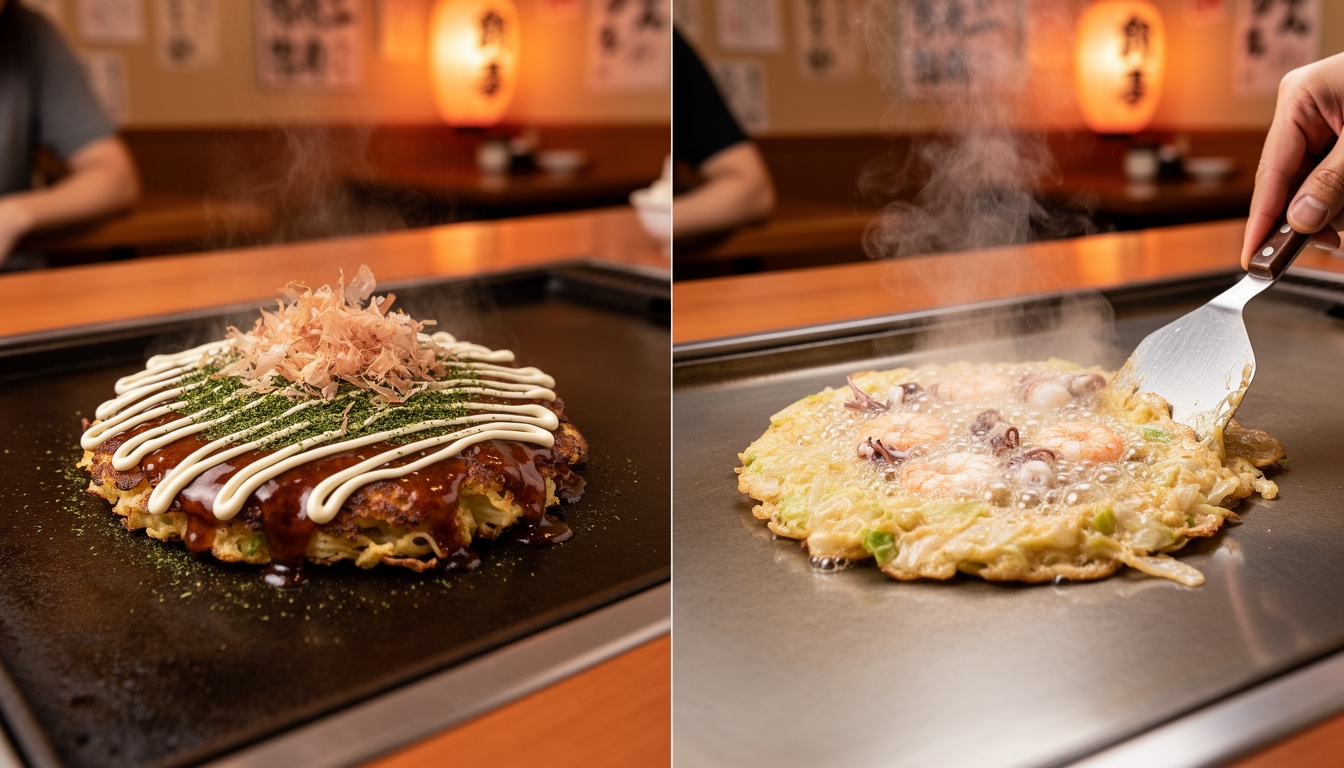
A sizzling encounter on an iron griddle can say more about a place than any landmark. Two of Japan’s most magnetic street-food experiences—Okonomiyaki and Monjayaki—are both savory pancakes, yet each tells a different story of region, rhythm, and ritual. One arrives as a thick, comforting pancake born in Kansai and layered into ceremony in Hiroshima; the other arrives as a glossy, gooey crowd-pleaser from Tokyo’s Tsukishima, eaten straight from the teppan with a tiny spatula. This piece unwraps the culinary theatre behind those differences: batter chemistry, cooking techniques, and the distinct eating styles that transform mere ingredients into a communal performance. Practical travel notes, real-world phrases to use at an okonomiyaki-ya, calorie context for mindful eaters, and a short on-the-ground route to taste both dishes in their hometowns are included. A fictional traveler—Hana, a curious digital nomad—threads the narrative, moving from the neon of Tokyo to the street-food bustle of Osaka, showing why visiting both is not a luxury but a cultural shortcut to understanding modern Japanese cuisine. Read on to decide which Japanese dish should hit your plate first and how to make the most of every savory bite.
- 🔎 Quick takeaway: Monjayaki = gooey, social, Tokyo specialties; Okonomiyaki = hearty, pancake-like, Kansai/Hiroshima pride.
- 🍳 Cooking techniques: Monjayaki = ingredients ring + watery batter; Okonomiyaki = mixed batter, flip like a pancake.
- 📍 Where to go: Tsukishima for monjayaki, Dotonbori and local okonomiyaki-ya for Osaka/Hiroshima styles.
- 🥢 How to eat: Monjayaki with a tiny spatula straight off the teppan; Okonomiyaki sliced and topped with sauce and mayo.
- 🧭 Plan it: Combine both on a Japan itinerary to taste regional contrasts — see a sample 7-day Japan itinerary for route ideas.
Okonomiyaki vs Monjayaki: Quick side-by-side food comparison for travelers
For anyone deciding between these two iconic Japanese dishes, a clear table helps. It captures texture, origin, and how each fits into a day of travel — from a light snack with drinks to a full, satisfying meal. This food comparison is built to guide ordering and expectations at the teppan.
| Feature | Monjayaki 🍜 | Okonomiyaki 🥞 |
|---|---|---|
| Texture | Runny, gooey, slightly crispy edges 🍶 | Thick, fluffy, pancake-like 🧱 |
| Typical calories | ~250–350 kcal per serving ⚖️ | ~400–550 kcal per serving 🍖 |
| Cooking method | Ingredients ring → pour watery batter → scrape & share 🔄 | Mix → pour thick batter → flip → top with sauce 🔁 |
| Origin | Tokyo (Tsukishima) 🗼 | Kansai (Osaka) & Hiroshima regions 🏯 |
| How to eat | Hagashi (tiny spatula) from the griddle 🍴 | Cut into wedges with spatula, eat with chopsticks/fork 🍽️ |
Cooking techniques and teppan rituals: mastering the methods behind the dishes
Understanding the cooking techniques explains why the two dishes feel so different. Monjayaki’s batter reads like soup—mostly dashi and water—with only a dash of flour. The solid ingredients are cooked first, arranged into a ring, then the liquid is poured into the center. Watching the batter bubble and scrape toward crusty bits is part of the joy.
Okonomiyaki relies on a heavier batter (wheat flour, egg, often grated nagaimo) binding shredded cabbage and proteins into a cohesive pancake. Kansai-style mixes everything before cooking; Hiroshima-style layers components, adding noodles for extra body. Both are teppan theatre: the griddle is the stage, and the spatula is the performer’s tool.
- 🔧 Essential tools: hera / kote (metal spatulas) for flipping and serving.
- 🗣️ Useful phrases: “Tsukutte moraemasu ka?” — Could you make it for us?; “Mō taberaremasu ka?” — Can we eat it yet?
- 🌿 Dietary note: For gluten-free travellers, check a specialized guide before ordering — see the gluten-free Japan guide.
Hana, the digital nomad in this narrative, learned to ask staff to cook the first one; watching the rhythm of the teppan calmed her impatience and taught the timing for perfect senbei (crispy bottom crust). Key insight: technique shapes texture, and knowing the method elevates the tasting.
Watching a local make monjayaki is almost a rite of passage; this video captures the choreography and the satisfying scraping ritual that follows. After watching, travelers often feel ready to attempt their own mini performance.
Where to try them: Tokyo specialties and Osaka/Hiroshima destinations for the best experience
Geography matters. To taste each dish where it belongs is to taste history. Monjayaki is most at home in Tsukishima, Tokyo: a narrow street lined with monjayaki-ya where locals gather after work. The vibe is nostalgic and approachable. Okonomiyaki is woven into Osaka’s everyday culture and elevated to spectacle in Hiroshima with its layered construction.
For a street-food deep dive, pair a Dotonbori walk in Osaka with a guide to the city’s snacks — it’s a perfect complement to an okonomiyaki stop. See the curated suggestions in the Osaka street food guide for recommended stalls and the best times to go.
Practical tips for where and when to go
Weeknights and early evenings are prime for monjayaki in Tokyo; weekend afternoons work well for okonomiyaki in Osaka. For a multi-city food tour, slot monjayaki into Tokyo days and save okonomiyaki for Kansai — many itineraries recommend this pairing for pacing and authenticity.
Planning tip: put this trip into a longer plan if time allows; see a flexible route suggestion like a 3-week Japan itinerary to connect city highlights and culinary stops. Key insight: regional context amplifies flavor — eat each dish where its story started.
Video guides make restaurant procedures less intimidating; learning the local order and cooking sequence will turn a first visit into a memorable shared ritual.
How to eat: step-by-step dining rituals for Monjayaki and Okonomiyaki
Eating technique is as much a part of the dish as the ingredients. Here are simple, traveler-friendly steps to maximize enjoyment and cultural authenticity.
- 🍽️ Monjayaki steps: 1) Watch the staff or ask them to cook the first round. 2) Use the small spatula (hagashi) to scoop small portions directly from the teppan. 3) Save the senbei (crispy bottom) for a smoky finish.
- 🥢 Okonomiyaki steps: 1) Mix or watch the cook mix the batter (Kansai) or observe the layered build (Hiroshima). 2) After cooking, top with okonomiyaki sauce, mayonnaise, katsuobushi, and aonori. 3) Cut into wedges and share.
- 🍻 Pairing tip: Both are excellent with beer or highball; monjayaki especially suits a lighter, social evening.
When Hana scraped the first sweet-smoky bite of senbei, the communal joy of monjayaki became obvious: the dish rewards patience and attention. Key insight: eating style determines memory — the way it’s served creates the story.
Deciding which to try first: a practical traveler’s decision guide
Limited time? Choose based on mood, appetite, and location. Monjayaki is ideal for light, social nights in Tokyo; okonomiyaki fits better when hunger demands a filling, structured meal in Osaka or Hiroshima. For a balanced itinerary, alternate: taste monjayaki in Tokyo early in the trip, then head west for okonomiyaki where it’s woven into local life.
- 📌 If short on time: prioritize the dish that matches the city — Monjayaki in Tokyo, Okonomiyaki in Osaka or Hiroshima.
- 🧭 If planning a longer route: combine both across a multi-city plan — sample routes are available in various itineraries, including a 10-day Japan itinerary or a 14-day Japan itinerary.
- 🍽️ If calorie-conscious: choose monjayaki with seafood to keep calories lower.
Hana chose monjayaki first to embrace Tokyo’s communal evening culture, then rewarded herself with a towering Hiroshima-style okonomiyaki — a perfect narrative arc. Key insight: context + craving = best first choice.
What is the main difference between Monjayaki and Okonomiyaki?
Monjayaki uses a runny, dashi-based batter that’s cooked on the teppan after forming a ring of ingredients; it’s eaten straight from the grill with a small spatula. Okonomiyaki uses a thicker flour-and-egg batter mixed with cabbage and toppings, flipped like a pancake and served with sauce, mayonnaise, katsuobushi, and aonori.
Where in Tokyo is best to try monjayaki?
Tsukishima is the spiritual home of monjayaki, with a concentrated street of monjayaki-ya known as Monja Street. The neighborhood’s restaurants offer authentic, local atmospheres ideal for a first taste.
Can these dishes be adapted for dietary needs?
Yes. Many restaurants will adjust toppings or offer seafood-and-vegetable options to reduce calories. For gluten-free travelers, consult a specialized resource before ordering — see the
Both are iconic but different: Osaka (Kansai-style) mixes ingredients into the batter for a classic, homey profile; Hiroshima-style layers ingredients and often includes noodles for a denser, stacked meal. Eating each in its home region reveals their full character.Is it better to eat okonomiyaki in Osaka or Hiroshima?